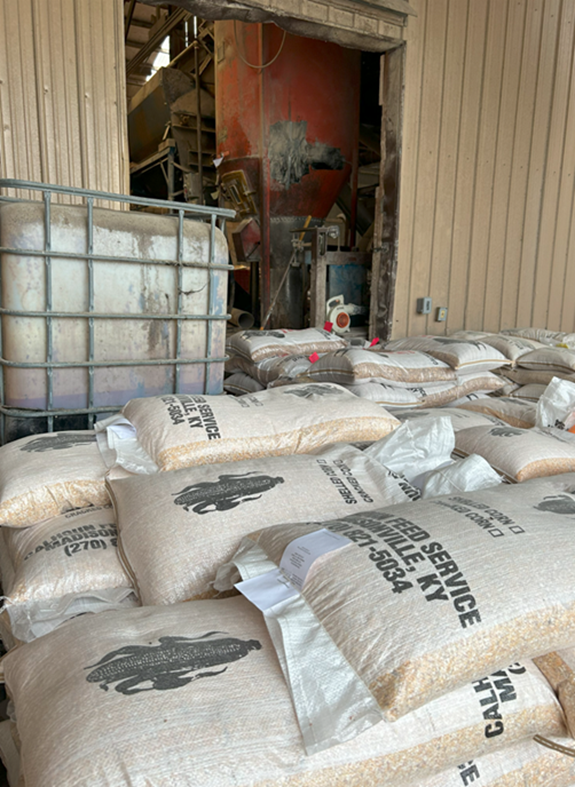
Bagged Feed Mill Operations Explained
A feed service is an example of an operation that stores various raw materials with which to manufacture finished products. The bagged feed milling process transforms raw materials (BOM items) into a finished bagged product, typically a 50 pound bag. The following provides some detail on the milling operation.
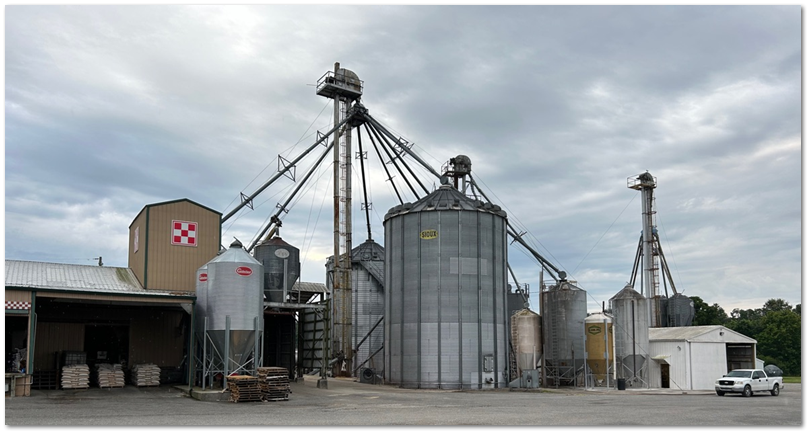
The foundation of feed manufacturing lies in raw materials that include:
-
Grains: Such as corn, wheat, and barley.
-
Oil seeds: Like soybean and sunflower.
-
Protein Sources: Like fish meal and poultry meal.
-
Minerals, Vitamins, and Additives: Enzymes, probiotics, etc.
The Manufacturing process includes the following:
-
Grinding: Raw materials are ground to the desired particle size.
-
Mixing: Ingredients are blended to create a uniform mixture.
-
Pelleting: The mixture is compressed into pellets using heat and pressure.
-
Cooling and Coating: Pellets are cooled and coated with fats or other additives.
-
Packaging: Finished feed is packaged into bags or bulk containers.
The bin used to mix raw grains and other ingredients in a feed operation is commonly known as a batching bin or ingredient bin. These bins are specifically designed for storing and dispensing various components needed for feed production. Each ingredient (such as ground corn, soybean meal, wheat middlings, etc.) has its own dedicated bin, and the contents are precisely measured and mixed to create a balanced feed formula.
In the batching process, the raw materials are carefully weighed and combined according to the desired recipe. The batching bin ensures accurate ingredient proportions, which directly impact the nutritional quality of the finished feed. Proper design and management of these bins are essential for efficient feed production.
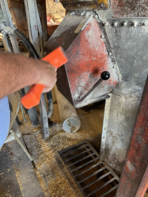
Into the Batching Bin go the materials used to create the finished product. Various augers and pumps deliver weighted materials into the bin where the mixing occurs. At this operation, feeds that contain molasses are mixed in the vertical mixer, while dry feeds (those without molasses) are mixed in the horizontal mixer.
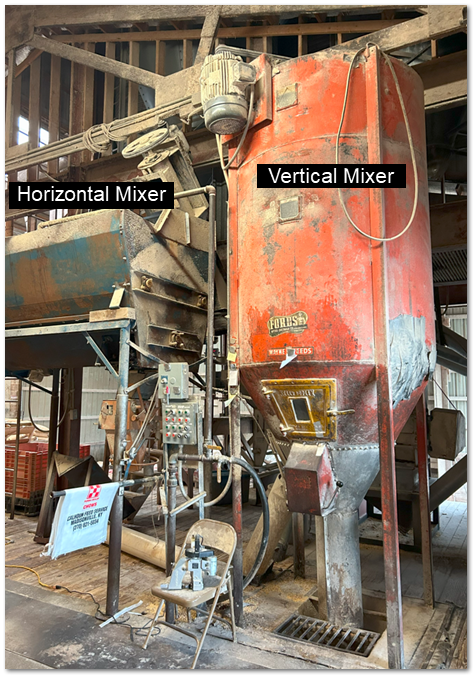
Inside the Batching Bin is an auger, which continually mixes the components of the finished good.
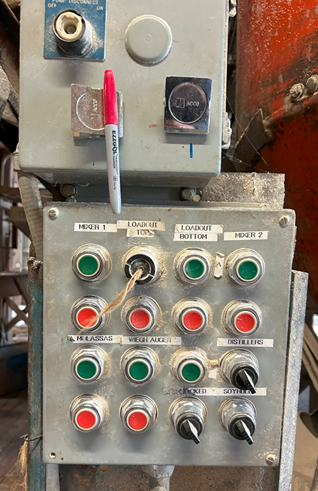

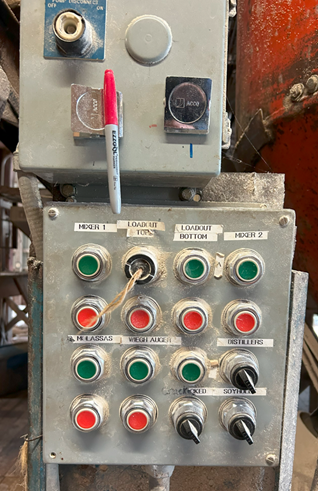
The control panel allows the operator to control the distribution of raw materials and ultimately mix the ingredients.
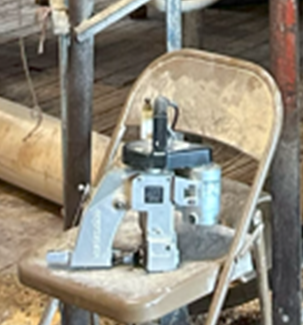
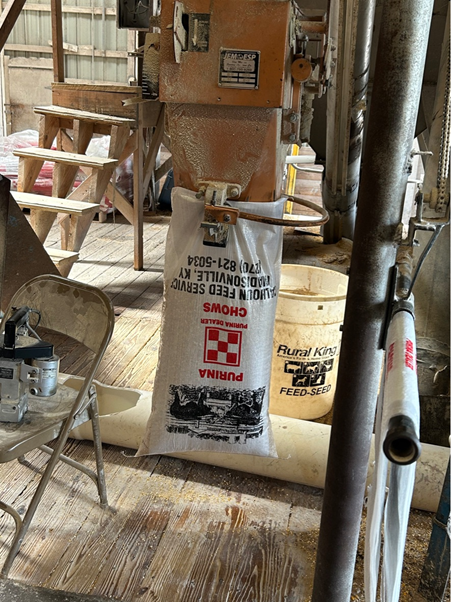
Once mixed, the bagging operation includes loading the 50 pounds of finished product into feed bags and using a handheld sewing machine to stitch the bag closed, incorporating the ingredients tag with the manufactured product.
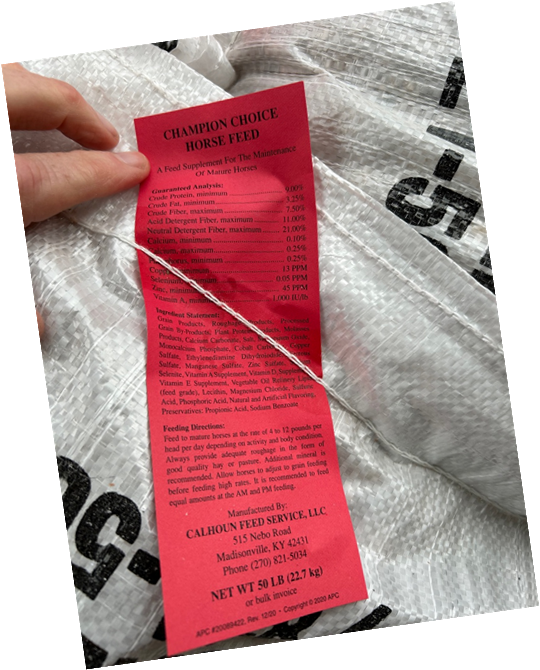
The ingredient tag includes the nutritional values of the finished product, certifying the contents.
 |
|
 |
Pallets of 50 pound bags of finished materials are temporarily stored under cover near the milling operation.
The pallets of finished product are then either trucked to the customer's location or arranged at the retail operation for sale to the public.